AI for Women's Empowerment in India
MONDAY, JANUARY 5, 2026
Author: Akanksha Dhanraj
Location: Uttar Pradesh ,India
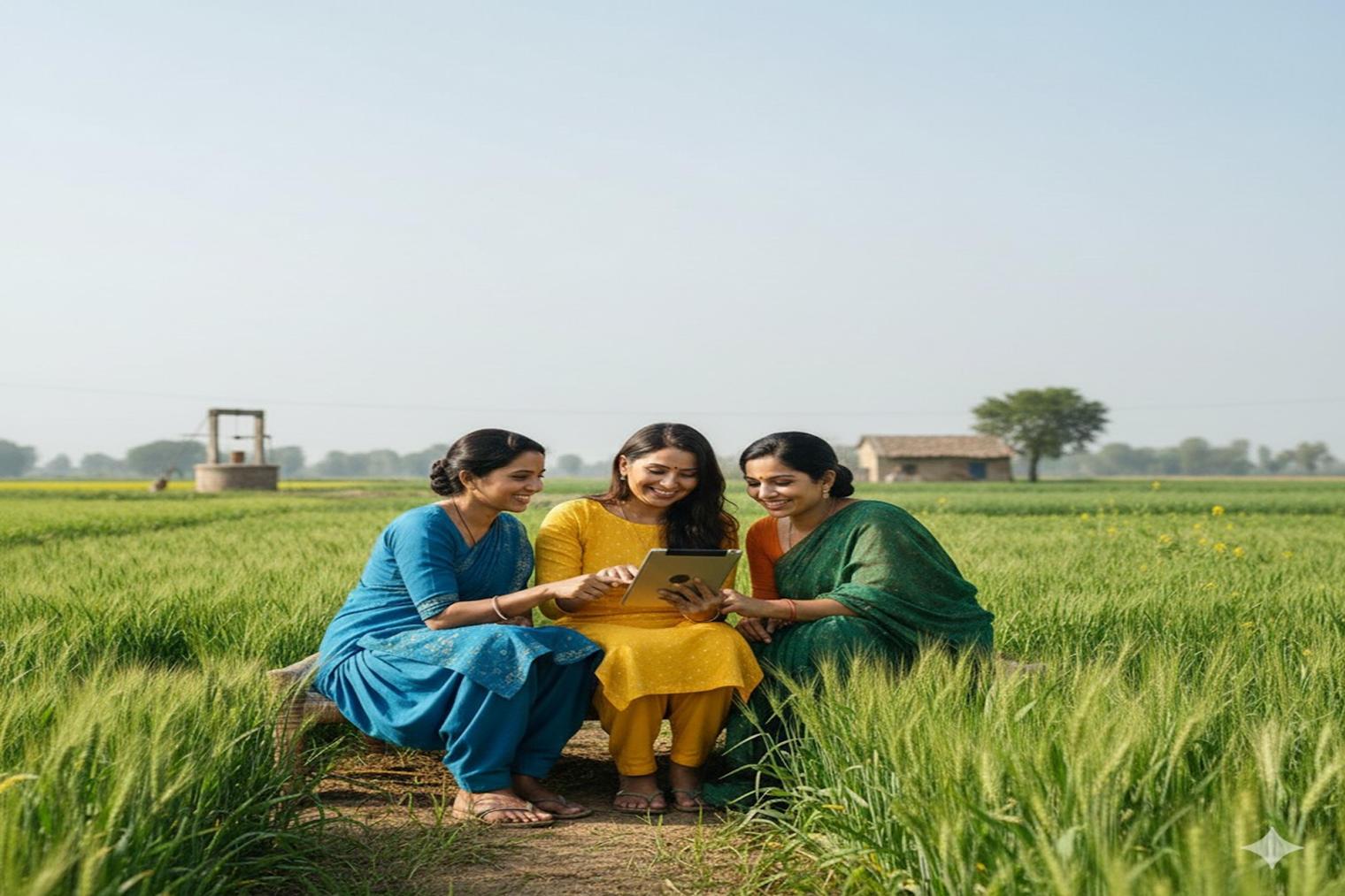
Is Artificial Intelligence a threat to women’s livelihoods, or could it be the catalyst that finally closes the gender gap in India's workforce?
The headlines often paint a dystopian picture. A recent report by UN Women, titled The Gender Snapshot 2025, delivers a sobering statistic: nearly 28% of women’s jobs globally are at risk of automation by AI, compared to just 21% for men. The warning is clear without deliberate intervention, the digital revolution could displace millions of women who are currently concentrated in routine, process-driven roles.
However, in India, where the Female Labour Force Participation Rate (FLFPR) has shown a promising rise to 41.7% in 2023–24, the narrative is far more nuanced. While the risk of displacement is real, a quiet revolution is brewing in the country’s hinterlands. From "Drone Didis" monitoring crops to rural entrepreneurs using AI for inventory management, Indian women are proving that technology isn't just something that happens to them; it is a tool they can wield.
The question, therefore, is not whether AI will change women’s work, but whether we are prepared to build the infrastructure that allows women to shape that change.
The Double-Edged Sword: How AI Impacts Women Differently
To understand the solution, we must first confront the problem. The impact of AI is "gendered" because the global workforce is gendered.
According to a study by the International Labour Organization (ILO), women are disproportionately represented in clerical, administrative, and service-oriented roles. In India, this includes vast numbers of data entry operators, customer support agents, and back-office processors. These are the "low-hanging fruit" for automation tasks that Generative AI can perform faster and cheaper.
If we view AI solely as an efficiency engine, women stand to lose the most. But if we view AI as an augmenting force, the script flips.
-
Lowering Barriers: Generative AI removes the "coding barrier." You no longer need to know Python to build a website or SQL to analyze sales data; you just need to know how to ask the right questions (prompting).
-
Hybrid Roles: The economy is shifting toward jobs that require "human-in-the-loop" skills, empathy, complex judgment, and care. Roles like AI-assisted telehealth coordination or personalized tutoring rely heavily on these traits.
-
Micro-Entrepreneurship: For the millions of women running home-based businesses, AI can act as a free legal advisor, marketing agency, and accountant rolled into one.
AI Literacy as Economic Infrastructure
For too long, digital literacy initiatives have treated technology as a "luxury skill" something to be learned after basic needs are met. In the AI era, AI literacy is economic infrastructure, as vital as electricity or banking access.
This shift is already yielding results. Evidence from the corporate sector shows the immense potential of "low-tech" AI adoption. For instance, Hindustan Unilever’s Project Shakti, which empowers rural women entrepreneurs, reports that 85% of women in the program now use the 'Shikhar' app to manage their stores. By using AI-driven insights for stock ordering and inventory, these women have seen their household incomes rise by 30-40%.
This proves a critical point: You don't need to teach a rural woman how to build an AI model. You need to teach her how to use it to solve her specific problems.
Yashoda AI: A National Template for Readiness
While corporate initiatives are valuable, a national transformation requires a scalable public model. This is where Yashoda AI, the National Commission for Women’s (NCW) flagship initiative, is quietly rewriting the playbook.
Launched in May 2025 in collaboration with policy innovation group Future Shift Labs, Yashoda AI has already trained over 3,600 women across 14 states by November 2025. But what makes it truly distinct isn't just the numbers, it's the method.
Unlike traditional computer classes that teach generic skills, Yashoda AI is built on a "Safety First” approach. The curriculum recognises that for a woman in a semi-urban town, the fear of "digital arrest" scams or deepfake harassment is a bigger barrier to entry than a lack of technical skill.
The ‘AI Sakhi’ Ecosystem- The program’s brilliance lies in its human layer. It trains local women leaders as "AI Sakhis" (AI Friends) peer mentors who serve as the village’s first responders for digital queries.
-
Trust Agents: An AI Sakhi doesn't just teach tools; she de-mystifies them. When a local woman receives a suspicious video call, she turns to her AI Sakhi to verify if it's a deepfake.
-
Vernacular Tools: The initiative distributes the "AI Digital Passport," a personalised booklet available in Hindi and regional languages. This allows women to track their learning journey from using easy-to-access tools like Google Lens for translation to using voice bots for accessing government schemes, without the barrier of Language.
By partnering with universities for workshops and hosting "Creators' Roundtables" in cities like Mumbai, the program is creating a cross-class movement. It positions AI literacy not as a technical subject, but as a life skill essential for safety and dignity in the modern world.
The Pathway: From Awareness to Employability
To scale this effectively, we must visualise the journey not as a single step, but as a progression from safety to economic power:
-
Stage 1: Awareness (The Shield)- It begins with defence. Women learn to identify deepfakes and secure their data, turning the fear of online threats into the confidence to navigate the digital world safely.
-
Stage 2: Literacy (The Tool)- Next, trust builds into utility. Women master practical tasks like using Google Lens to translate medicine labels or GenAI tools like Gemini to draft loan applications turning abstract technology into a daily problem-solver.
-
Stage 3: Employability (The Sword)- Finally, competence becomes capital. Whether it’s a weaver designing new patterns with AI or a small business owner automating customer replies, technology becomes a force multiplier for productivity and profit.
Conclusion: Shaping the Future, Not Just Surviving It
The belief that "AI will take women's jobs" is only true if we allow it to be. When AI literacy is treated as a fundamental right accessible, multilingual and safety-led the narrative shifts from disruption to empowerment.
Initiatives like Yashoda AI are not just awareness programs; they are economic imperatives. They demonstrate that when you equip women with the right tools, they don't just adapt to the future of work they build it.
As we look toward Viksit Bharat @2047, our vision must be inclusive. We cannot have a developed nation if half its workforce is left behind in the analogue age. The future must be not only AI-powered, but AI-enabled and women-led.
Blogs